

Open to new-grad ML & backend roles · 2026

Abhishek Kumar Shah

AI/ML & Backend Engineer

I ship production ML and the backends that serve it. Currently a full-stack engineer at Drop, a social platform for real-world events, an AI Fellow at Fusemachines, and a Computer Engineering graduate (ACEM, 2026) in Kathmandu who collects his own datasets on farms.

Kalanki, Kathmandu · Nepal abhishekshah134567@gmail.com +977 986-731-0644
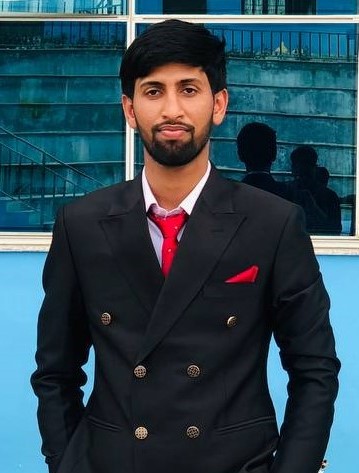
Portrait of Abhishek Kumar Shah
DropFull-stack · 2026
FusemachinesAI Fellow
PrixaResearch collaborator
Drop · web app
#1 committer

Top contributor on the Next.js website and second on the Node.js backend of a live social platform.

Cattle biometrics
86.6%

Top-1 identification across 455 cattle identities with a ResNet-50 + ArcFace embedding model (94.2% Top-5).

Field data
90 cattle

Custom dataset collected on farms across the Kathmandu valley: face, left/right body and muzzle images per animal.

Fusemachines fellowship
16 builds

Weekly deliverables from FastAPI services and churn models to a RAG + multi-agent support assistant.

01 — About

Engineer first, researcher when the problem needs it.

abhishek@kathmandu — zsh
$ whoami Abhishek Kumar Shah $ cat role.txt now = "Full-stack Engineer @ Drop" fellow = "Fusemachines AI Fellowship '26" degree = "B.E. Computer Engineering · ACEM · 2026" focus = ["computer vision", "ML systems", "backend"] $ ls research/ cattle-muzzle-biometrics/ monkey-deterrence/ skin-lesion-segmentation/ $ echo $STATUS # open to ML / backend roles · remote or Kathmandu $

I'm a Computer Engineering graduate from ACEM (class of 2026) who spent his final year shipping production code: at Drop I own backend services, the website and the recommendation service of a live social app, from API design and real-time chat to the EC2/Docker deployment and the health runbook.

On the research side I build computer-vision systems for problems that matter in Nepal. As a Prixa Student Collaborator I collected a cattle dataset on real farms and trained a muzzle-based biometric identifier. Under Assoc. Prof. Dr. Shankar Dhakal I'm working on a monkey-deterrence system to protect farmers' crops.

I like problems where the model and the system around it both have to be right: data collection, training, evaluation, then serving it fast and keeping it up.

Currently
  • Shipping at Drop — feed, chat, media CDN, payments and ops for a product with real users.
  • Finishing the Fusemachines AI Fellowship — final-stage work on agentic RAG systems and evaluation.
  • Monkey-deterrence research — vision-based detection for crop protection, with Dr. Shankar Dhakal.
  • Graduated — B.E. Computer Engineering, ACEM, 2026.
02 — Experience

Where I've shipped.

Industry work, an AI fellowship and applied research. Every line is something I built or owned.

Jan 2026 — Present Kathmandu, Nepal Industry

Full-Stack Engineer · AI/ML & Backend

Drop (dropit.club) · social platform for real-world events · joined as AI/ML & Backend Intern

  • Top committer on the Next.js website, second on the Node.js API; own features from API design through the web UI.
  • Built features end to end (API + web): hub group chat with per-hub storage billing, message forwarding and pinning, Instagram-style moments, spin-and-win lucky draw, QR-ticketed Explore events, Apple in-app-purchase coin store.
  • Own the recommendation service for the For-You feed (Python, FastAPI, FAISS, sentence-transformers) and migrated the droplet feed from push fan-out to pull with a RabbitMQ drain, removing an always-on recommender loop.
  • Built a Cloudflare Worker CDN that streams private Wasabi videos with HMAC-tokened URLs and edge caching; added a signed-URL cache in front of S3 for feed media.
  • Diagnosed 108-megapixel avatars being decoded on every paint: ran a production shrink job on ~860 images, capped uploads and cut page layers from 240 to 50.
  • Own the EC2/Docker deployment for API and website: migrated the production instance, resolved OOM incidents, wrote the weekly/monthly health runbook. Closed a public ticket-data leak and a batch of missing-auth routes.
Node.jsTypeScriptExpressMongoDBSocket.IORabbitMQRedisNext.js 16React 19AWS S3 / Lambda / EC2Cloudflare WorkersDockerFastAPIFAISS

2026 — Present Final stage Fellowship

AI Fellow

Fusemachines AI Fellowship 2026 · selected cohort · 16 weekly builds

  • ML foundations with production habits: churn models with SMOTE inside CV folds and SHAP (test AUROC 0.81), plus a leakage demo showing how SMOTE-before-CV inflates AUROC to 0.93.
  • NLP & LLMs: CRF-based NER on CoNLL-2003/WNUT-17, LSTM text classification in PyTorch, and encoder (BERT / RoBERTa / ModernBERT) vs decoder (Qwen + LoRA) comparison for support-ticket routing.
  • Agentic systems: text-to-SQL agent with validator and self-correction loop over PostgreSQL; a RAG + tool-calling support assistant with an ONNX intent router (99.8% accuracy, ~1 ms) and a multi-agent dispute investigator with a verifier sub-agent (7/7 cases vs 3/7 single-agent).
  • Computer vision: surface-defect classification, an OpenCV fruit-sorting pipeline (CLAHE, morphology, Hough circles) and ONNX export of a ResNet-50.
PyTorchscikit-learnHugging FaceLoRA / PEFTChromaONNXFastAPIPostgreSQLDocker Composepytest
Ongoing ACEM, Kathmandu Research

Research Assistant · Monkey Deterrence System

Supervised by Assoc. Prof. Dr. Shankar Dhakal

  • Crop raiding by monkeys causes serious losses for farmers across Nepal's hills. The project is building a vision-based system that detects monkeys near farmland and triggers deterrents.
  • Research is ongoing; methods and results will be shared once the study is complete.
Computer visionPyTorchOpenCV
2025 — 2026 Kathmandu valley Research

Student Collaborator · Cattle Muzzle Biometrics

Prixa Student Collaborator program (selected) · repo

  • Assigned the Muzzle-Based Biometric Identification System for Cattle in Nepal as the collaborative research project. Collected a 90-animal dataset on real farms, then trained classical and deep models.
  • Best model: ResNet-50 + ArcFace embedding, 86.6% Top-1 / 94.2% Top-5 across 455 identities (EER 0.037, ROC-AUC 0.988). Built a Flutter app to register and identify cattle by camera.
TensorFlow / KerasArcFaceOpenCVLBP / HOG / GaborFlutter
03 — Projects

Selected work.

Fusemachines fellowship · LLM systems

ShopAssist AI — RAG + multi-agent support assistant

Customer-support assistant with retrieval, tool calling and an agentic dispute investigator that is checked by a separate verifier agent.

  • ONNX intent router: 99.8% accuracy, ~1 ms, 429 KB
  • Multi-agent investigation: 7/7 cases vs 3/7 single-agent
  • 27/27 correct tool calls on a deterministic eval harness
FastAPIChromaONNXClaude / OpenAI-compatibleDocker

Problem

Support bots either hallucinate or cannot act. The goal was an assistant that grounds answers in a knowledge base, calls real tools (order lookup, ticket creation) and can investigate a dispute over multiple steps without going off the rails.

What I built

  • FastAPI service with a Streamlit UI; Chroma vector store using all-MiniLM-L6-v2 on onnxruntime for retrieval.
  • Tiny ONNX intent router (429 KB, ~1 ms) in front of the LLM: 0.998 accuracy, 0.9985 macro-F1.
  • Provider-agnostic LLM layer (Anthropic Claude or any OpenAI-compatible endpoint such as Groq, Gemini, OpenRouter, vLLM, Ollama) with a fallback ladder, tenacity retries, token-bucket rate limiting and a TTL cache exposed via an X-Cache header.
  • Tools lookup_order, search_knowledge_base, create_support_ticket with closed Pydantic JSON schemas; endpoints /chat /ingest /health /metrics /schema; Docker Compose with an optional vLLM Mistral-7B profile; 20 offline pytest tests and a benchmark script.
  • Agentic dispute investigation (POST /investigate): up to 10 steps with 3 investigative and 3 terminal tools, a separate verifier sub-agent, per-role token accounting, context clearing, repeat detection and fault injection.

Result

  • Custom deterministic eval harness (7 cases): multi-agent 7/7 completion vs 3/7 single-agent, 27/27 correct tool calls, at +19% tokens (model: gpt-oss-120b on Groq).

Stack

PythonFastAPIStreamlitChromaonnxruntimePydanticDocker Composepytest
Research · with Dr. Shankar Dhakal

Monkey deterrence system for crop protection

Computer-vision research into detecting monkeys near farmland and triggering deterrents automatically. Crop raiding is a serious, widespread problem for farmers in Nepal's hills.

  • Detection of monkeys from camera footage
  • Automatic deterrent actions on detection
  • Ongoing study; results to be published
PyTorchOpenCVObject detection

Problem

Monkeys raiding fields is a widespread problem across Nepal's hills: crops are lost every season and guarding fields by hand is not practical.

Approach

  • Camera-based monkey detection using deep-learning object detection.
  • Logic that turns detections into deterrent actions, so the system can respond without a person watching the field.

Status

Ongoing research under Assoc. Prof. Dr. Shankar Dhakal at ACEM. Results and code will be published when the study completes.

PyTorchOpenCVPython
Research · Medical imaging · CNN + U-Net

Skin lesion classification & segmentation

Classifies dermoscopy images into 7 lesion types and segments the lesion region, served through a Flask app that returns class, calibrated confidence, malignancy note and a mask.

  • HAM10000: 10,015 images, 7 classes, class-balanced to 5,000/class
  • U-Net with Dice + focal-Tversky losses on 10,015 image/mask pairs
  • Custom CNN vs ResNet-50 vs MobileNet transfer-learning comparison
TensorFlow / KerasU-NetFlaskNumPy

Problem

Early triage of skin lesions depends on expert dermatologists who are scarce outside cities. The model gives a first-pass class and highlights the affected region.

What I built

  • Classification: custom CNN over the 7 HAM10000 classes (bkl, nv, df, mel, vasc, bcc, akiec). Heavy class imbalance handled by resampling and augmenting every class to 5,000 images (rotation, shift, shear, flip, contrast) with a 70:20:10 split; compared against ResNet-50 and MobileNet transfer learning.
  • Segmentation: custom U-Net trained on 10,015 image/mask pairs with combined Dice and focal-Tversky loss.
  • Serving: Flask app that loads both models, resizes uploads to 256×256, returns the top class with temperature-scaled softmax confidence, lesion metadata (full name, malignancy, recommendation) and a thresholded binary mask rendered inline. Seeds fixed for determinism.

Stack

PythonTensorFlow / KerasNumPyMatplotlibFlask
Hackathon · Protobytes 2.0 · Feb 2026

Universal IMU-to-health pipeline

Self-supervised motion embeddings that standardise accelerometer data across wearables, with fall detection and activity recognition on top of a frozen encoder.

  • 83.0% overall accuracy across three device datasets
  • 96.3% on the Fall class; 95.6% on Walking
  • 1D-CNN encoder + NT-Xent contrastive loss, Streamlit dashboard
PyTorchContrastive learningStreamlitUMAP / t-SNE

Problem

Every wearable samples motion differently, so health models trained on one device fail on another. The team (Coder Rex, 4 ACEM students) built a device-agnostic embedding so one classifier can serve many devices.

What we built

  • IMUEncoder: 1D-CNN (3 → 32 → 64 → 128 channels, global average pooling, projection head) producing 128-d embeddings, trained with NT-Xent contrastive loss (temperature 0.5).
  • MLP fall-detection classifier and a multiclass activity classifier on frozen embeddings.
  • Datasets: SisFall, WISDM, PAMAP2 plus smartwatch/phone samples; Streamlit dashboard with t-SNE/UMAP views of the embedding space.

Results

  • Overall 83.0% accuracy; per device SisFall 82.4%, WISDM 88.6%, PAMAP2 69.4%.
  • Fall 96.3%, Walking 95.6%; Sitting is the hard class at 42.5% (the next thing to fix).
Mobile · Flutter · on-device

Similar image detection app

Flags duplicate or near-duplicate photos before you save them, entirely on-device with no model download and no backend.

  • Perceptual hashing: pHash + dHash compared by Hamming distance
  • Tiered verdicts: exact duplicate (≤3) vs very likely duplicate (≤5)
  • Single- and multi-image picking; hashes persisted locally
Flutter / Dartimageimage_pickershared_preferences

Problem

Phones fill up with repeated shots. Cloud-based duplicate detection costs money and privacy; this app shows the same result can be had with a few lines of signal processing on the device.

How it works

  • Computes an 8×8 grayscale average hash (pHash) and a 9×8 gradient hash (dHash) for each image with the image package.
  • Compares against every previously stored hash by Hamming distance: ≤3 on both hashes is an exact duplicate, ≤5 is a very likely duplicate.
  • Pick one or many photos via image_picker; a dialog warns or confirms, then the hash is persisted with shared_preferences.
04 — Skills

Tools I reach for.

Everything here has been used in a shipped project above, not just a tutorial.

Languages

daily drivers
PythonTypeScriptJavaScriptCC++DartSQLHTML / CSS

ML & data

train · evaluate · explain
PyTorchTensorFlow / Kerasscikit-learnHugging Facesentence-transformersFAISSChromaONNXSHAPPandas / NumPyMatplotlib

Deep learning & vision

architectures I've trained
ResNetMobileNetDenseNetSwin TransformerU-NetArcFaceLSTMBERT / LoRAOpenCVLBP · LPQ · HOG · Gabor

Backend

APIs · realtime · data
Node.jsExpressFastAPIFlaskMongoDB / MongoosePostgreSQLMySQLRedisRabbitMQSocket.IOZod / PydanticREST

Cloud, DevOps & testing

ship it and keep it up
AWS S3 / Lambda / EC2WasabiCloudflare WorkersDockerCI/CDFirebaseLinuxGit / GitHubPlaywright / JestpytestPostman

Frontend, mobile & hardware

from browser to board
Next.jsReactRedux ToolkitTailwindFramer MotionFlutterStreamlitESP32Raspberry Pi PicoArduinoPixhawk / KK2.1.5 drones
05 — Credentials

Certificates & achievements.

Fellowships, hackathons, competitions and research selections.

Fellowship · 2026

Artificial Intelligence Fellowship — Recipient

Fusemachines (fuse|ai) · selected cohort, 16 weekly builds

Certificate of participation, Protobytes Hackathon 2.0, ACEM, February 2026
Hackathon · 12–14 Feb 2026

Protobytes Hackathon 2.0 — Participation

PACE · Dept. of Electronics & Computer Engineering, ACEM · 60-hour hackathon, team Coder Rex

View certificate
Hackathon · earlier edition

Protobytes Hackathon 1.0 — Participation

PACE · Advanced College of Engineering and Management

Research · 2025

Prixa Student Collaborator — Selected

Prixa · assigned the cattle muzzle biometrics research project

Competition · Techfest 2022

Represented Nepal at Techfest, IIT Bombay

Runner-up in Meshmerize · IIT Bombay's annual science and technology festival

Competition

Runner-up, Robo Soccer

Orbit Engineering Expo

Volunteering · 2022

Volunteer & Referee, Cozmo Clench

Technorion Nepal 2022

Volunteering

Volunteer, Startup Fest

Robotics Association of Nepal

Education

  • B.E. Computer Engineering — Graduated 2026 Advanced College of Engineering and Management (ACEM), Tribhuvan University 2022 — 2026
  • +2 Science (Mathematics) Capital College and Research Center (CCRC) 2019 — 2021 · GPA 3.55

Resume

One page, same names, dates and stacks as this site.

Download PDF
06 — Contact

Let's build something that runs in production.

I'm looking for new-grad ML engineering or backend roles, and I'm happy to talk about research collaborations in computer vision. Email is the fastest way to reach me.

Emailabhishekshah134567@gmail.com
Phone / WhatsApp+977 986-731-0644
GitHubgithub.com/Abhishekshah02
LinkedInlinkedin.com/in/abhishek-shah002
LocationKalanki, Kathmandu, Nepal · open to remote